



GUIDE
Curtain tracks
Curtain tracks are a popular choice in many homes, offering both flexible curtain hanging and a stylish, discreet solution that suits most rooms. In this guide, you'll get a complete overview of how to measure and install ceiling/wall mounted curtain tracks, what to consider before purchasing, as well as practical tips and answers to common questions – all to help you find the right curtain track for your windows.

How to measure for curtain tracks
Wall-to-wall curtain track
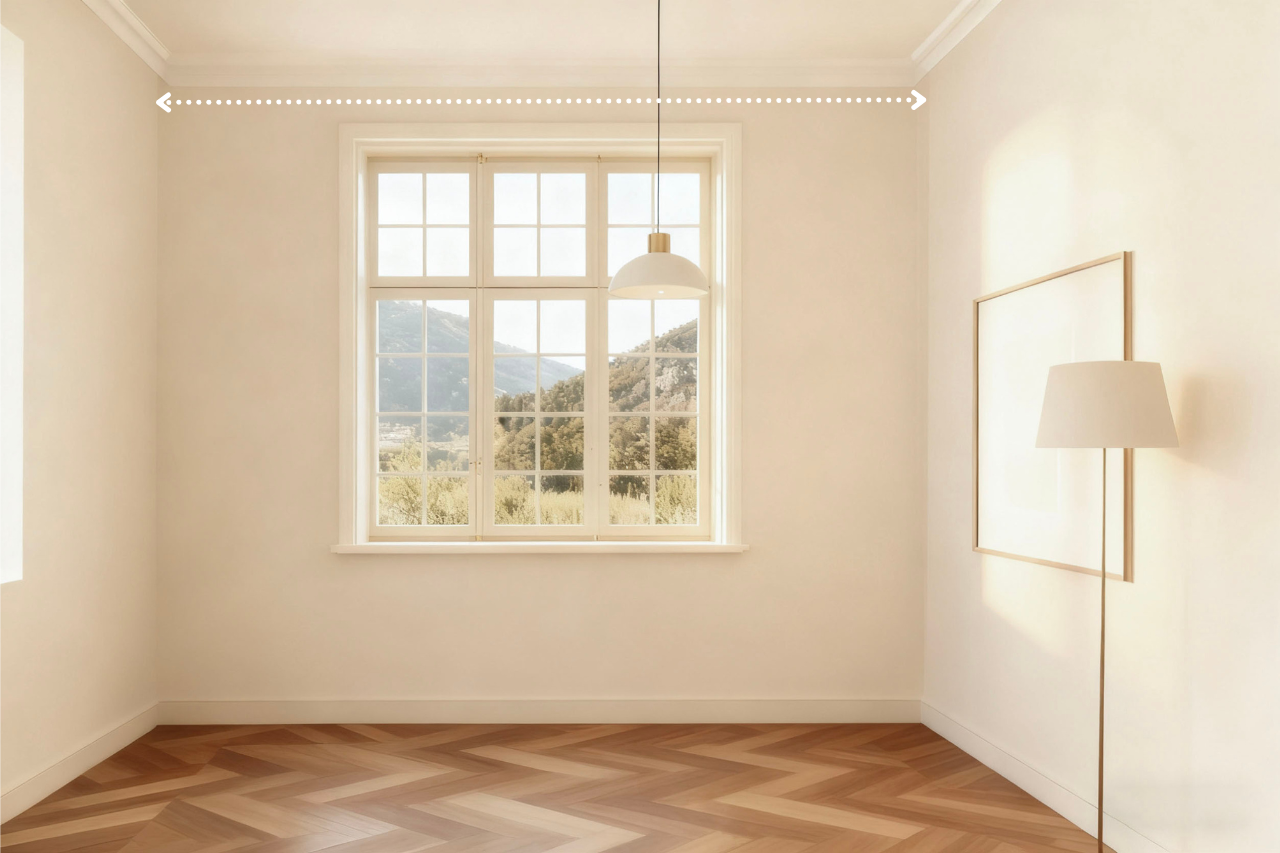
If your curtain track is to be installed wall-to-wall, start by measuring the entire distance between the walls. To prevent the track from being too long and not fitting, we recommend subtracting 2 cm from the total measurement.
This margin makes installation significantly smoother, while not affecting the curtains' drape or the visual appearance. The result is a curtain track that fits perfectly without touching the walls.
Curtain track for curtains next to the window
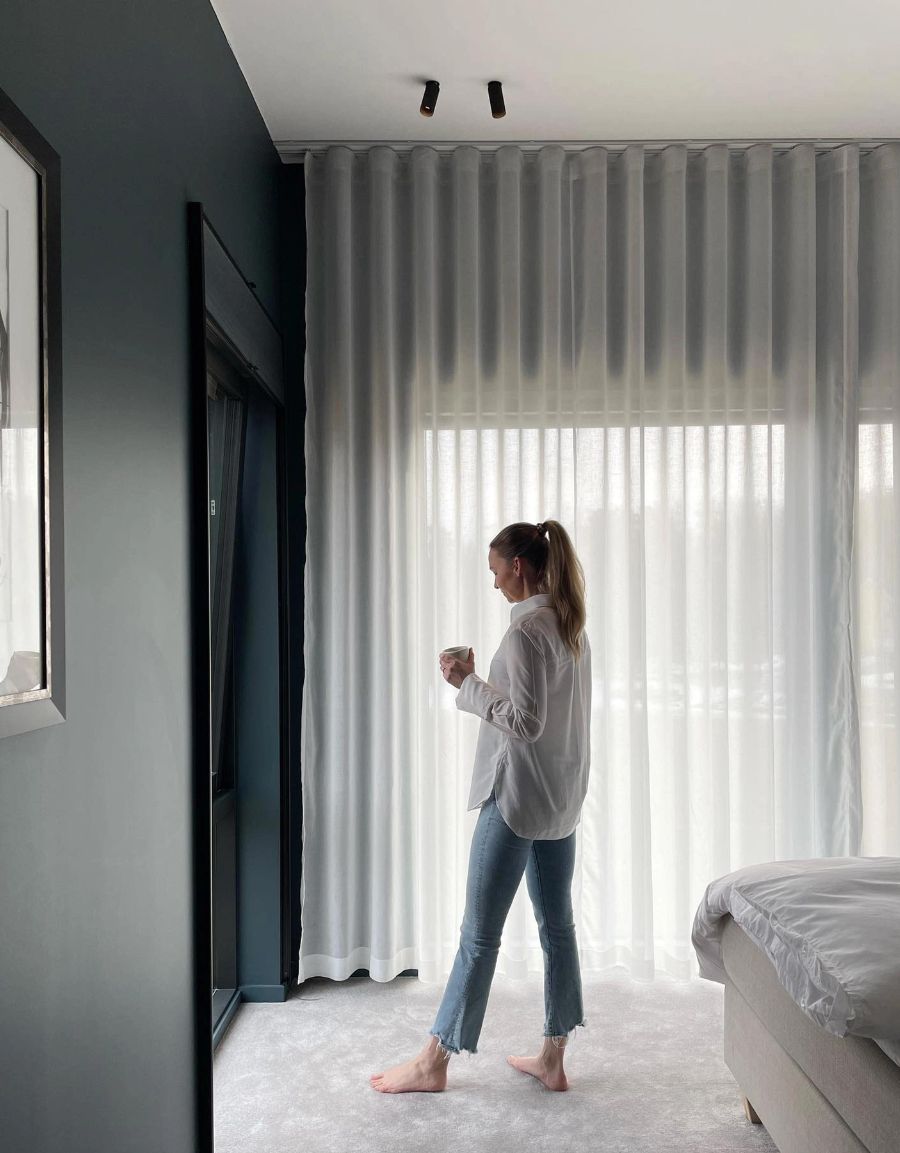
If your curtains are to hang beside the window – rather than cover the whole wall – choose a curtain track in exactly the length you want. We recommend that the curtains frame the window rather than cover it when they are open. This maximises light transmission, makes the room feel larger and lets the curtains highlight the window instead of hiding it. This solution works particularly well when you want to create soft waves with curtains at the side of the window.
This also applies to dimout curtains. If you want to be able to close the curtains fully, it's an advantage to make the track wider than the window itself. The wider the curtains, the less light gets in at the sides.
That's why we always recommend choosing a curtain track that is at least 1 metre wider than the total width of the window – that is, approximately 50 cm extra on each side. This gives you both maximum dimout and a clean, stylish look around the window.
How to install a curtain track
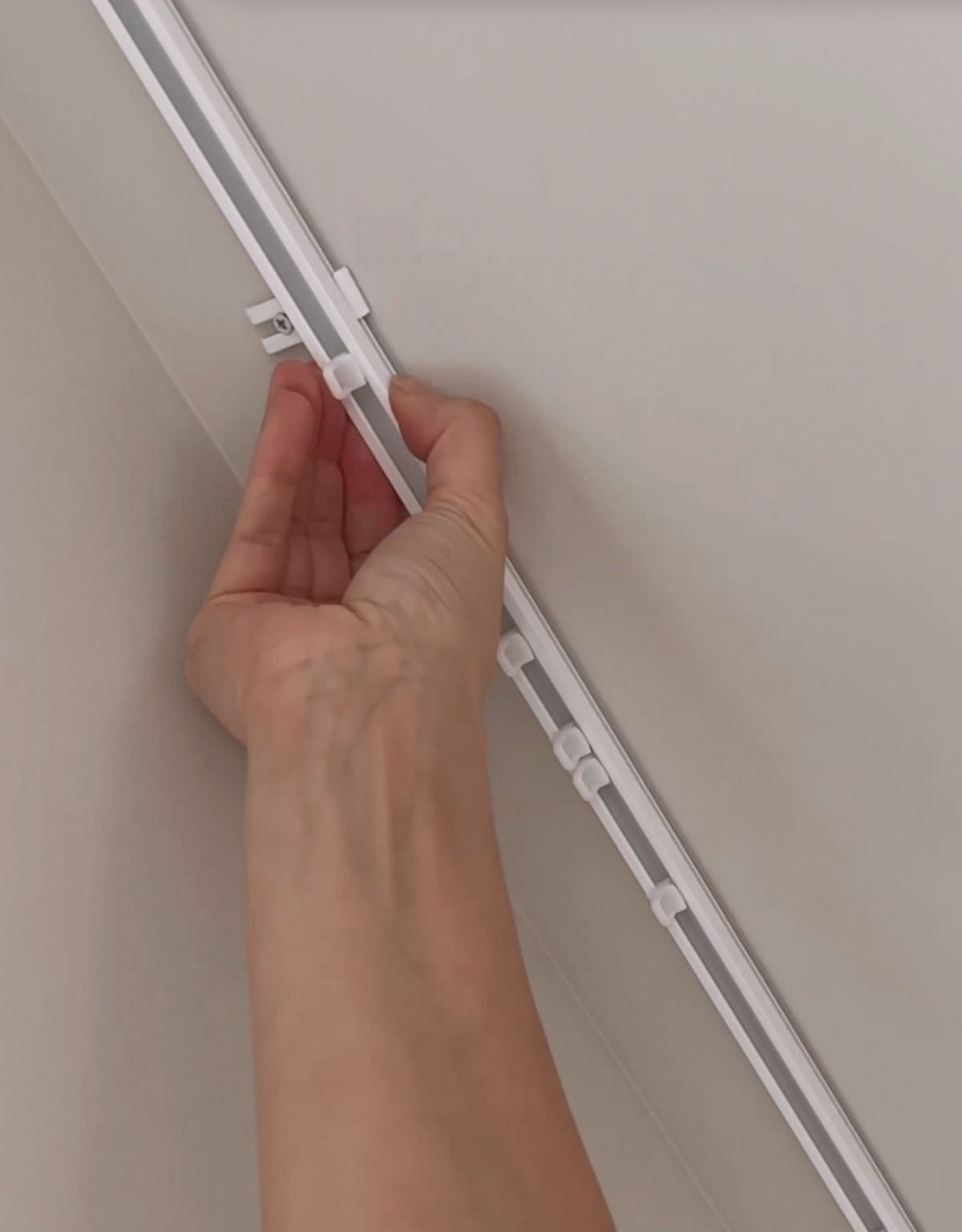
When it comes to installing curtain tracks, the instructions may vary slightly depending on the model and whether you are mounting the track on the ceiling or on the wall. However, there are several general tips that are good to keep in mind regardless of the type of curtain track you choose.
Tips for mounting curtain tracks
Consider the surface. Many curtain tracks come with screws, but depending on the ceiling or wall material, you may need to add other screws and plugs to ensure a secure installation.
Measure the position before you start. Carefully mark where the track or brackets will go before you drill or screw – that way you avoid unnecessary screw holes, and your curtains will hang straight and securely.
Space the brackets evenly. An even spacing of approx. 50 cm between the brackets stabilises the track. If the track is joined, you may need extra brackets at the joiner, especially if you are hanging heavier curtains.
Follow the installation instructions for your specific model. Different curtain tracks have different mounting solutions, so always check the specific instructions for the track you have chosen. Here you will find our instruction videos showing how to install our most common models.
How far from the wall should the curtain track be mounted?
When you're working out how far from the wall your curtain track should be, there are several factors to take into account. The first is any obstacles, such as window sills, radiators or pipes. If any of these protrude further than the wall itself, always measure the distance from the edge of the obstacle, not from the wall, so that the curtains can hang freely.
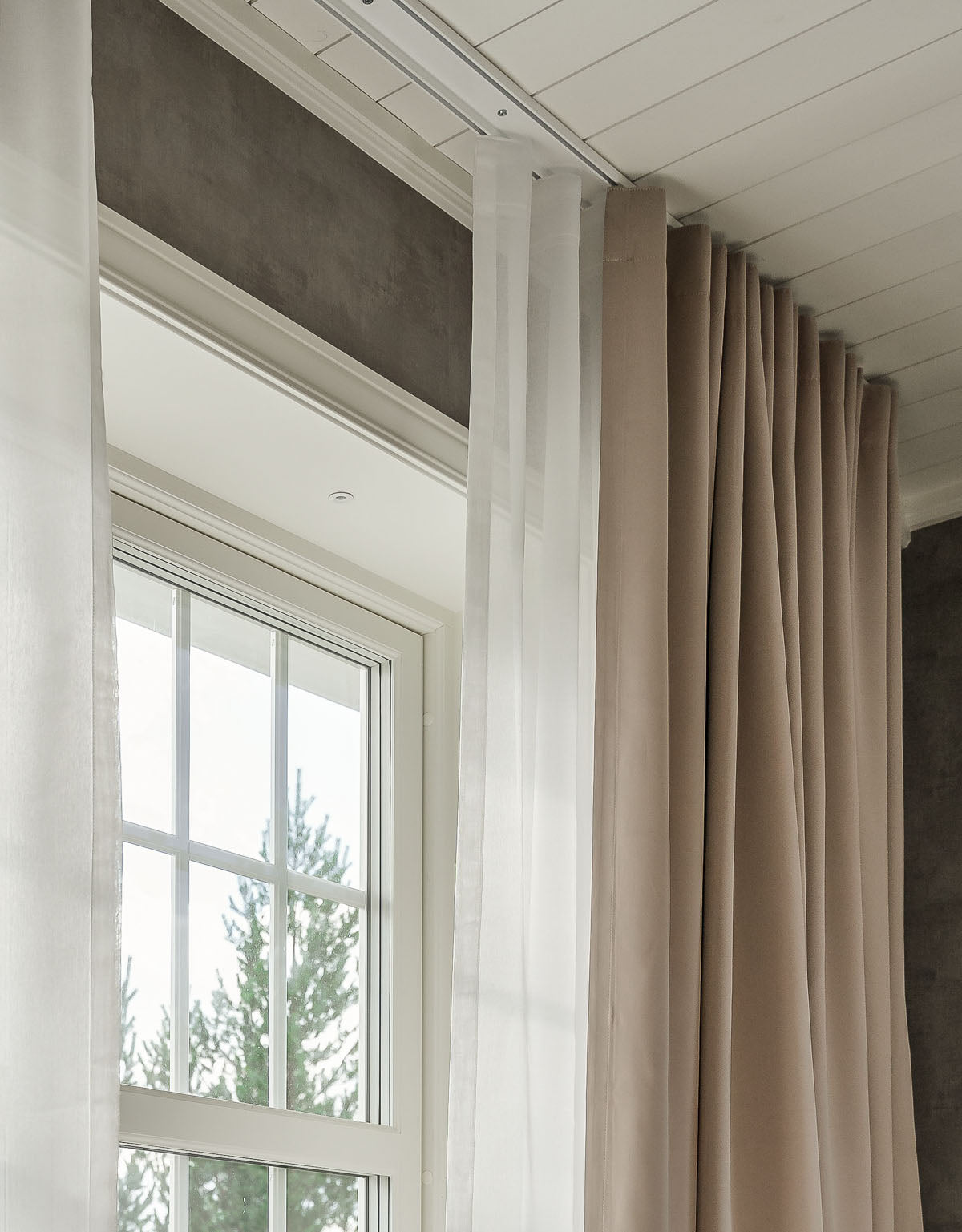
The choice of curtain heading also affects how far from the wall the curtain track should be placed. Pleat hooks project very little, which means the track can be mounted closer to the wall. Full waves, on the other hand, project about 8 cm back, which means the curtain track needs to be placed approx. 10 cm out from the wall or from the edge of the windowsill. If you feel the curtain track ends up too far out and looks odd from the side, angle bends are available for several of our most common tracks, so you can cover the gap between the track and the wall with the curtains at the sides.
With ceiling mounting, it is easy to adjust the distance between the curtain track and the wall by simply positioning the track further in or further out on the ceiling. With wall mounting, however, you may need to add various accessories, such as wall brackets in different depths, to get the right position. For more detailed information – read our guide to installing a curtain track on the wall.
Extra long curtain tracks
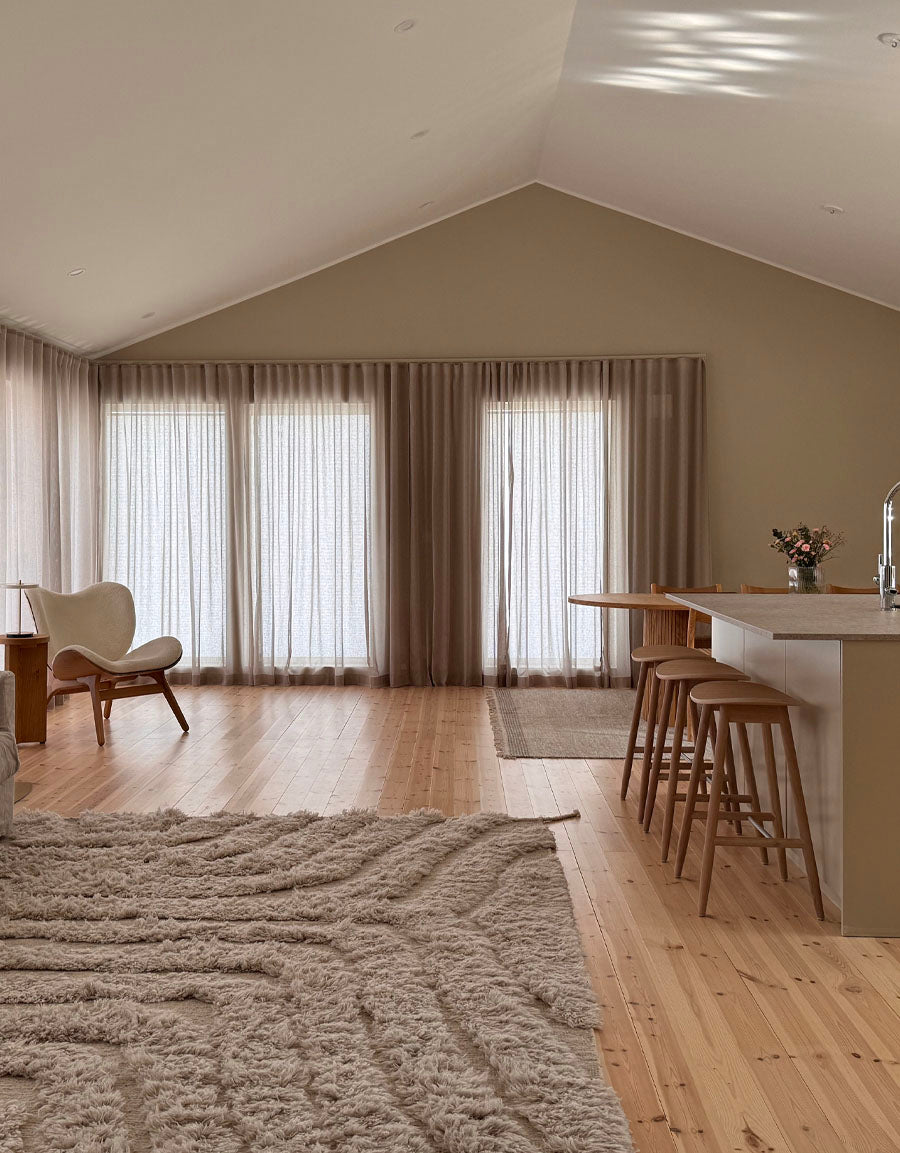
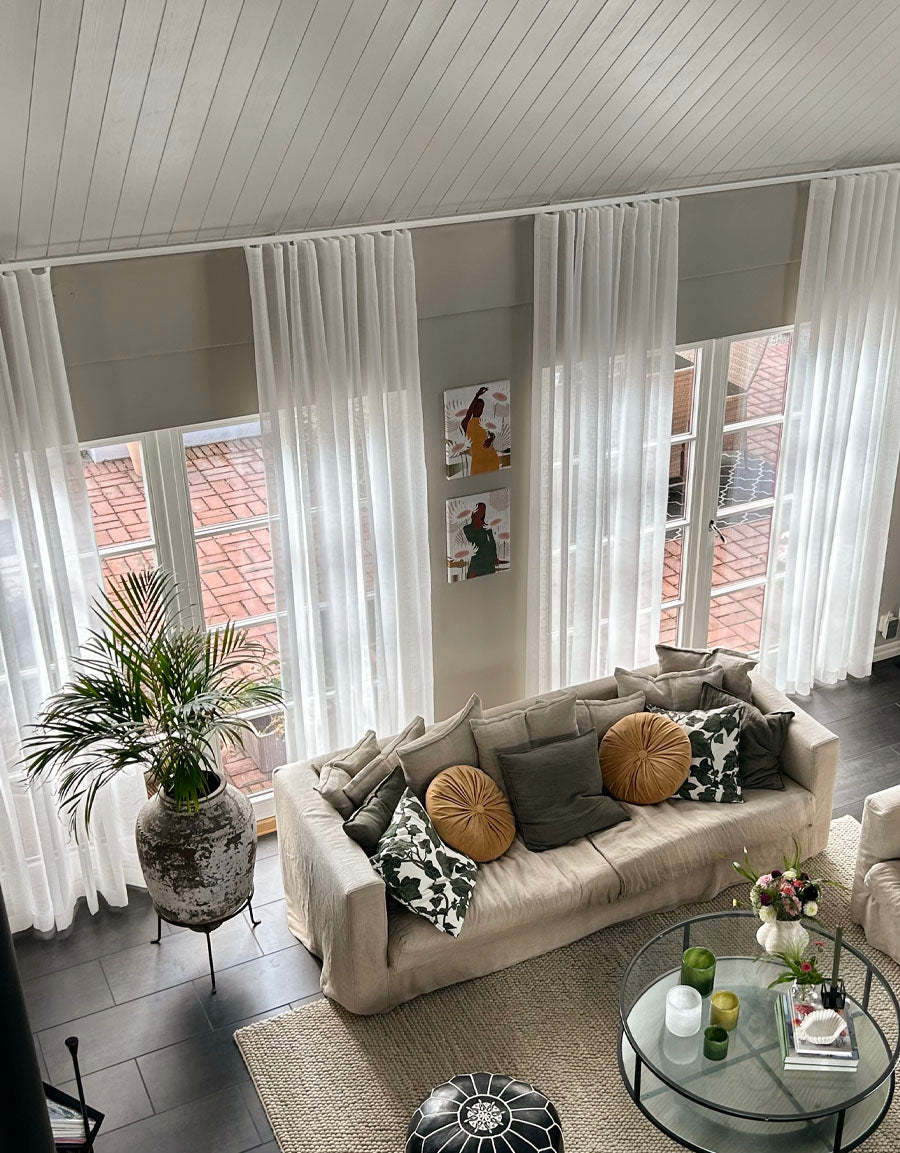
Using long curtain tracks across wide areas has several advantages:
- Creates a soft and luxurious hotel feel
- Makes windows look larger and maximises light transmission
- Provides flexible light filtering and easy adjustment of privacy
- Can be extended almost indefinitely thanks to joinable tracks
If you need an extra-long curtain track, you can either order a single long track (up to 5.8 metres) or join several shorter tracks with a joiner.
Join several tracks into one long track
Using several shorter tracks can be practical, especially if you live in a flat with a stairwell or lift. It makes transport easier and simplifies handling during installation. A long track often needs several people to get it into place.
One-piece track with no joiner
For those who prefer a uniform look, many curtain tracks can be ordered in full lengths of up to 5.8 metres. Although the joiners are usually discreet, a single length of track can give a more seamless impression.
Some tracks, such as the hotel curtain track with two separate channels, cannot be joined and can only be ordered in fixed lengths. If you want double curtains but would like a joinable solution, you can instead mount two single tracks in parallel for the same effect. See our guide to hotel curtains on a curtain track here.
Curtain tracks for heavy curtains
With heavy curtains, such as dimout curtains, the load on the track can be high. That is why it is important to choose a curtain track that can take heavy curtains, whether you mount it on the ceiling or on the wall. Many tracks work well even with a lot of weight, but you may need to use more brackets with shorter spacing between them to prevent the track from sagging.
Another common problem is that the curtains can start to glide less smoothly as the load increases. You can avoid this by choosing a curtain track with roller gliders, which allows the curtains to run easily even when they are heavy.
For more detailed advice on choosing a track and accessories for heavy loads, read our guide to curtain tracks for heavy curtains.
Common questions about curtain measurements
Should I choose a ceiling-mounted or wall-mounted track?
It depends on your circumstances. The choice is also a matter of aesthetics – some people want curtains from floor to ceiling, while others prefer to hang them closer to the window.
A ceiling-mounted track is sometimes easier to install and makes it easy to adjust the distance from the wall.
A wall-mounted track may require more planning and accessories, especially if you need to adjust the distance. In some rooms, ceiling mounting is not possible at all, for example with sloped ceilings, stucco, or if it's not possible to drill into the ceiling.
How do you attach a curtain track to the ceiling?
A curtain track on the ceiling is usually attached with ceiling brackets that are screwed directly into the ceiling. Some models, like the hotel curtain track, have pre-drilled holes and can be mounted without separate brackets.
Bear in mind that different ceiling materials require different types of screws and plugs, so even with screws included, you may need to add fixings suited to your particular surface.
How far out from the wall should the curtain track be?
A curtain track should be positioned approx. 10 cm from the wall so that the curtains can hang freely if the curtain is to hang in waves. For pleats made with pleat hooks, the curtain can hang closer to the window.
If you have a windowsill, a radiator, or pipes that protrude further, always measure the distance from the edge of that object.
Which curtain track is best for full waves?
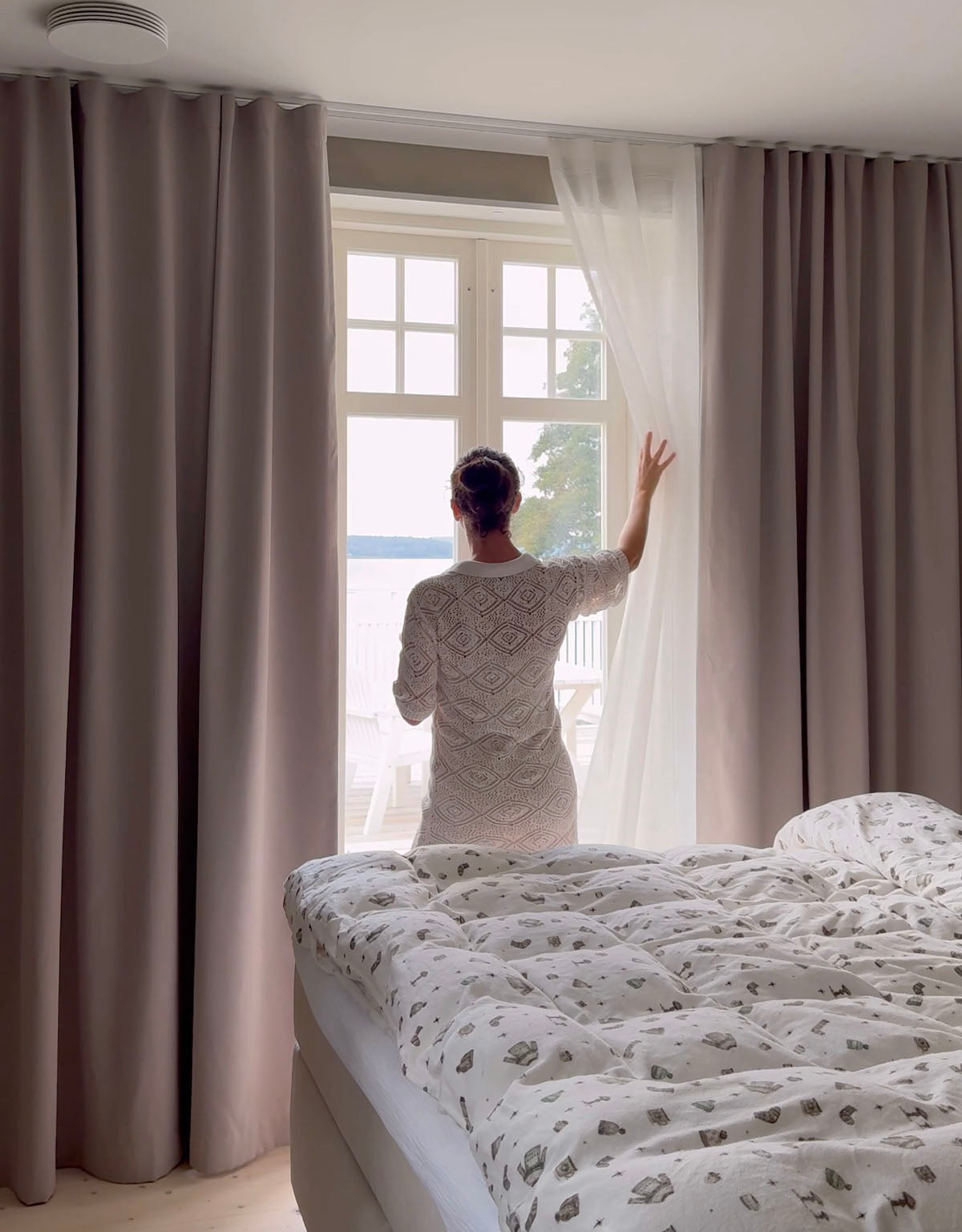
For full waves, a discreet curtain track allows the curtains to take centre stage. A neat U-track or a hotel curtain track for double layers is therefore a popular choice as they highlight the wave form without visually taking up space.
With full waves, the curtains need to be able to run both in front of and behind the track, so they need to hang below the track. With full waves, you therefore cannot cover the track, which makes a thin track the most discreet choice.
How do I cover my curtain track?
By combining the curtain track with pleat hooks with a short neck, you get a set-up where the curtain covers a large part of the track, as these hooks lift the curtain closer to the ceiling.
Bear in mind that this only works with certain models, as other tracks cause the curtain to hit the ceiling. In our overview of curtain tracks, you can see which models can be combined with these pleat hooks, short neck.
Curtain tracks for sloped ceilings, do they exist?
For sloping ceilings that incline in one direction, the curtain track can be mounted diagonally along the slope. Use corded gliders and a stop or brake, and note that the curtains may need to be re-hemmed to hang nicely.
However, if the ceiling slopes upwards from the wall, it's not possible to mount the track to the ceiling. In this case, you'll need a wall-mounted track installed as high as possible to achieve the same effect.
Can I cut the curtain track to the correct length myself?
Yes, you can cut most curtain tracks yourself as long as you cut perfectly straight, so that accessories like end stops still fit. However, the easiest option is to order a made-to-measure track, so you get a curtain track in the exact length you need.
How far apart should the rail mounts be?
Under normal load, the brackets should be spaced approximately 50 cm apart. For heavier curtains, you may need to place the brackets closer together to stabilise the rail and prevent it from sagging.
How do I install a curtain track in a corner?
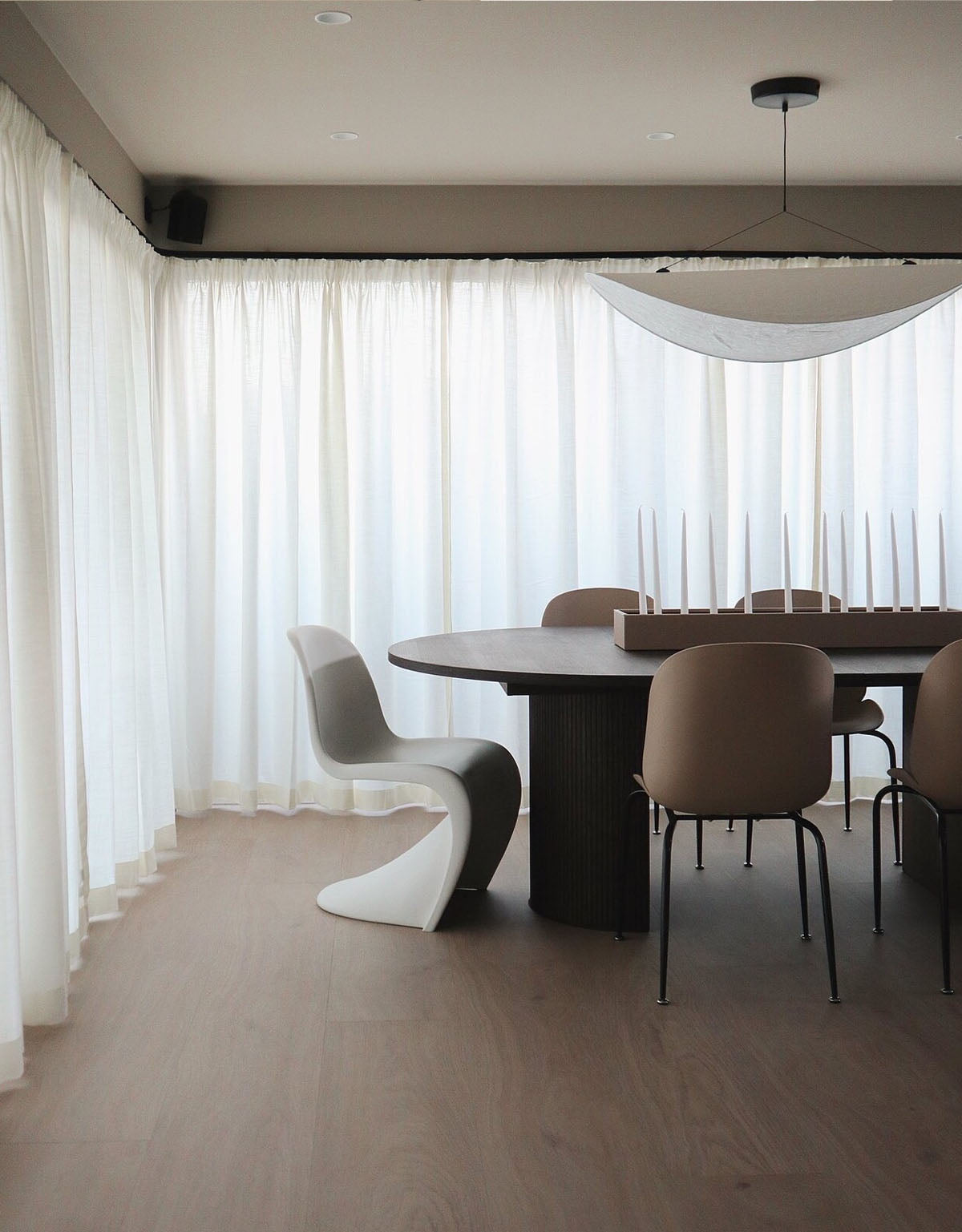
Many curtain tracks have corner bends or return bends that let you join the track at a corner. With such a bend, you can let the curtain run through or round the corner so that it hangs in one uniform, continuous line.
Which curtain tracks have two tracks?
For double curtain sets, you can choose a ceiling-mounted curtain track with two channels, known as a hotel curtain track. You can also achieve the same effect by mounting two single curtain tracks in a double layer.